Fifty Cameras, Fifty Rulebooks: Why Where You Shoot Matters More Than What You Shoot
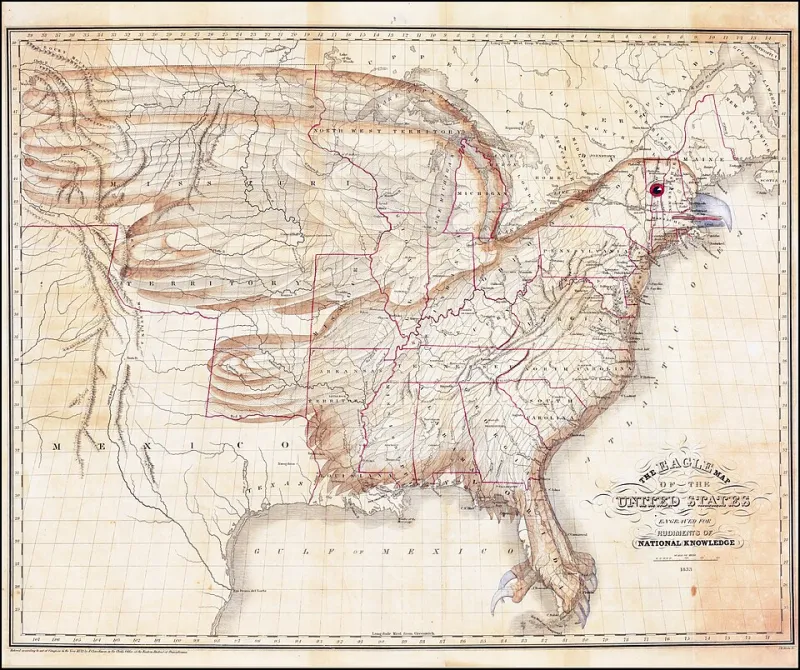
Photo: Isaac W. Moore (engraving) / Published by E. L. Carey & A. Hart, Philadelphia, Public domain, via Wikimedia Commons
Ask a mainstream filmmaker where they can shoot and they'll ask about permits. Ask an adult filmmaker and they'll ask about obscenity statutes, age-verification paperwork, county lines, and whether the local district attorney has a history. Location isn't a logistics question in this industry. It's a legal survival question.
The Federal Floor — and Why It's Not Enough
Start with the baseline. Federal law requires every performer in a sexually explicit production to be at least 18, with records documenting it — the infamous 2257 requirements. Every producer keeps (or should keep) copies of government IDs, model releases, and dates of production, indexed and ready for inspection.
That's the floor. The ceiling varies wildly, because obscenity in the United States is judged by 'contemporary community standards' — and communities differ. A production that's unremarkable in Los Angeles can invite prosecution in a conservative county in Florida or Tennessee. The Miller Test, the Supreme Court's framework, essentially asks whether the average person in your local community would find the material appeals to prurient interest. Your local community. Meaning the jury pool nearest to where the content lands.
The Risk Map, Roughly Drawn
A few broad strokes for traveling creators:
The established corridors. California remains the industry's gravitational center — two decades of occupational health regulations, established case law, and a local ecosystem that treats adult production as a business, not a scandal. Nevada, outside the counties you're thinking of, is similarly workable. Florida and Texas host major production hubs but have seen aggressive state-level legislative activity in recent years, particularly around age verification and platform liability.
The middle band. Most states fall here: not hostile, not welcoming, just governed by obscenity statutes whose enforcement depends entirely on local prosecutors and local politics. This is where the county line matters more than the state line.
The elevated-risk zones. Some states have passed laws explicitly targeting adult content distribution — age-verification mandates with steep penalties, expanded obscenity definitions, or laws allowing private citizens to sue producers. Shooting there isn't automatically illegal, but the margin for paperwork error is thinner, and the downside is steeper.
The Paperwork That Travels
Regardless of geography, the smart production kit is the same:
- Current government-issued IDs for every performer, verified in person, not over email
- Signed model releases with clear scope-of-use language
- Accurate production dates and a records custodian named in your 2257 filings
- STI testing documentation within whatever window your production standard requires — and increasingly, that's not just industry custom, it's insurance
- A local entertainment attorney's phone number, saved before you need it
Traveling creators shooting solo or with a partner should apply the same discipline. 'It's just my own content' doesn't exempt you from 2257 if you distribute it commercially, and it certainly doesn't exempt you from state obscenity law.
The Trend to Watch
The direction of travel is unmistakable: more states are legislating on adult content, not less, and the action has shifted from production to distribution — age verification laws, platform liability, and documentation requirements that ripple upstream to whoever made the content.
For studios, the calculus is increasingly simple: shoot where the legal infrastructure is mature, store where the cloud is safe, and never assume that what flies in one state flies in the next. For solo creators, the advice is blunter — read your own state's statutes, because the nearest prosecutor already has.